
from Instagram: http://instagr.am/p/NO9Gklxy2Q/
Nearly thirty years ago I was a teenage punk in New York City. On weekends, my sister, my friend Joshua and I would frequent the Village to hang out at what was the epicenter of US punk at the time. Most often we would go to Saturday and Sunday matinee concerts at CBGB’s, which was hollowed ground having been the place that launched the careers of the Ramones, Blondie, Talking Heads, Television, and others. It was also next door to the Chelsea hotel, where Sid Vicious was found next to a bloody Nancy Spungen.
We saw some of the best punk of the time including the Ramones, the Dead Kennedys, MDC, Bad Brains, Circle Jerks, Murphy’s Law, Channel 3, GBH, the Exploited, Cause for Alarm, and Agnostic Front, to name a few. We also saw a slew of terrible bands that I have luckily erased from memory. One of those awful bands was a group of kids just a year older than me named The Beastie Boys. The Beasties consisted of three boys and a girl that even by punk standards of the time, couldn’t play a lick. Also, they stood out from the rest of the crowd dressing in the style of rappers of the time. The crowd hated them, not only were they downright terrible, but they also tried to do rap. Imagine, white kids rapping!
A few weeks after we saw them at CBGB’s, we saw them again at a free concert in Thompson Square Park. The park was a well known heroine addict hangout, but that day it had been transformed into a punk hangout with lots of leather, mohawks, piercings, tattoos, braces, and boots. The hosts of the concert, a local Hare Krishna group, passed vegetarian food mixed with their religious pitch, while local bands played. I remember when the Beastie Boys were announced, there was a lot of grumbling in the mosh pit (we called it something else then). They soon broke into a live rendition of Cooky Puss. There wasn’t much slam dancing happening, instead we just laughed.
Carvel Cookie Puss commercials were very familiar to all of us New Yorkers, and this “song” was a great NYC joke. We started thinking that maybe they were not as terrible as we thought. By the time the Beasties started their reggae anthem, of the time, “Beastie Revolution” many of us joined them in pogoing and asked “why not a Beastie revolution?”
Weeks later my sister and I shared a subway ride with the three remaining Beastie Boys, Kate their drummer had left the band by then. All that I truly remember from that ride was that they were pretty silly. They did talk to us, I’m not sure what we talked about. That was the last time I saw them in person. Both of my sisters ran into them a few years later. By that time they were a big deal, and my sisters were just giggling fans, or at least one of them was.
I’ve been reading a lot in the past few days about MCA aka Adam Yauch and people’s reaction to his passing on Friday. Most of my Facebook and Google+ stream on Friday were filled with Beastie Boy videos and remembrances from my family and friends.
Adam was only one year older than me, a New Yorker and a Buddhist. In many ways I see myself reflected in his experiences, but we are/were of totally different worlds. I will miss the positive force that he became.
Like everyone else of my age, I’ve followed the Beasties’ career, and bought all their music. I’d like to say I was an early fan and that I knew them when. The reality is that I thought they were pretty awful then, and I did have a small interaction with them, but I didn’t really know them. I still have my Cookie Puss 12″ record, and I will continue to ask “why not a Beastie revolution?”
Have you ever had the aftertaste
When desperation subsides?
Life has kicked you in the teeth
You were flat on the ground
Swallowing your pride
And a good dose of blood
You looked around to see
What hit you so hard
Standing there wearing bloody boots
Was yourself smirking back
You are not what you thought
There was only one person
That could have taken you down
And it would always be yourself
Have you ever looked around
And found insanity waning?
You look in the rearview mirror
And see carnage behind you
What could have done that
Yes, it was you and you alone
But you are too good
You have thought
Turns out you were not
You are all too human
Have you ever reached out
And found another landscape?
You find that the calm
Means something else now
All that once was is gone
A new world stands there
You want to crawl back
For what you know
But that is long gone
Even if you can still see it
Have you ever been deafened
By the silence between heartbeats?
You die every second or so
And every breath is your last
And you are born again
Only to die once more
There is always calm
Somewhere and sometimes
There is always turmoil
When you least expect it

If you have read my previous posts, you know that we went on vacation to Spain at the beginning of November. We visited Madrid, Barcelona, and Sevilla. This was the first trip for us to Europe. We had originally talked about going to the UK, but as the trip got moved to later in the year we decided that Spain would make more sense. As the trip got closer I started thinking more and more about what it would be like to visit the country of my long ago ancestors. During the trip I posted a blog entry about my ancestry, and about what this trip was starting to mean. A month later, I can finally write what this trip was like.
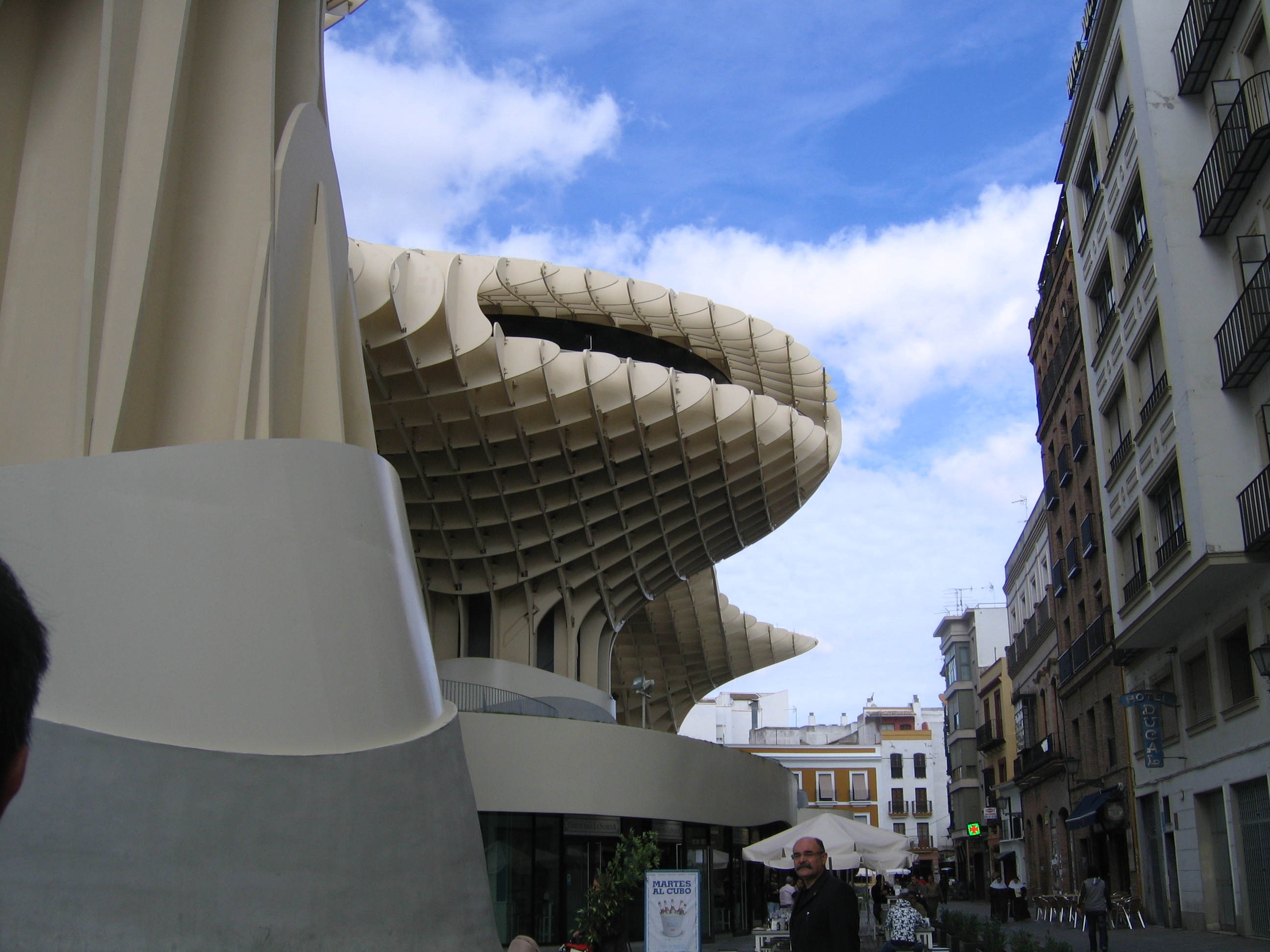
Plaza de la Encarnacion, Sevilla
Arrival
I love that some airlines show you exactly where you are at the moment. During this flight, after the second movie, the screen continually updated with our location. When we were just about over the coast of Portugal, I stopped reading and just watched out the window. I began seeing the outline of the coast, and soon I was seeing little Portuguese coast towns. That is when it hit me, I was about to arrive to Europe for the first time in my life. Maybe that is not a big deal to most people, but Europe has always figured large in my mental geography. Growing up I felt a tug of war in my heart between USA and Europe. USA was where everything cool was from, but Europe was where everything classic was from.
Once in Madrid, and what seemed like the longest walk in an airport, we were in a cab in the wee hours of a Monday morning driving into the city. I was dumbfounded being in Madrid. I always expected that my first trip to Europe would begin in Paris, London, or maybe Berlin, but never Madrid. As soon as I had that thought, I realized the cab radio was in Spanish, and not just any Spanish, but Castellano. Since I moved to the US, 33 years ago, there have been two kinds of Spanish accents that I have heard regularly on radio, TV, or other media, Mexican or Caribbean, usually Puerto Rican or Dominican. However, this was Castellano, the standard language, the language of Cervantes, Garcia Lorca, or Miguel Bose. The feeling of being home was nearly overwhelming. I looked at the streets and at the few souls walking in the street, and my eyes watered. I held back the tears, well because as my mom always told me “you’re a man, men don’t cry.”
“Quiero llorar porque me da la gana.” Federico Garcia Lorca

Garcia Lorca Statue in Madrid
That morning I saw the sunrise over the Iberian Peninsula and watched Madrid wake up. Cervantes once said “sea moderado tu sueño; que el que no madruga con el sol, no goza del día.” I did enjoy that day, and every day I woke up in my unexpected home.
Madrid
The streets of Madrid seemed at once very familiar, and very strange. The waves of people washed over us, as we walked. I didn’t expect to see so many Latin Americans everywhere we went. Of course, it makes sense, but Colombian accents would regular rise and wane around me, building that feeling that I was home. Madrid felt, and looked, like the old parts of my native Bogota.
Like Bogotanos, Madrileños seem like a serious and dour lot. Maybe it is because we were there in the rain, or maybe because the economy is not doing well. Whatever the reason, the people looked as familiar as those back in my native home. Speaking of that, when I realized that I looked like every other guy in the street with my dark hair, brown eyes, and short stature the feeling of home cemented. In the US, I’m not white, I’m brown and ethnic. In Spain, I was just another European, or just another Spaniard. For someone that “relishes” being the odd man out, it was comforting that I didn’t have to pretend there. I was just another guy.

Metropolis Building in Madrid
Eating in Madrid proved to be tricky, as we both expected, being vegetarian. It seems that every restaurant in Madrid, and every other part of Spain we saw, has the identical menu. The vegetarian tapas available to us were limited to Patatas Bravas, Torta Española and Manchego. If we had been vegan, we would have starved for sure. For one meal we had Indian, which is as familiar to us, as a burger is to an American carnivore. We did enjoy the café culture, and took every opportunity to eat outside even in the rain. We partook of the early evening snack mini-meal. Our hotel was right next to a Chocolate Valor http://www.valor.es/valor.asp café. We visited it every night we were in Madrid.
There was one thing, and only one thing that I needed to do in Madrid, go to El Prado, the national museum of Spain. I have to say that while the museum is amazing, I was a bit disappointed. The week before we left for Spain, Mandy and I spent two days at the American National Museum in DC. There we saw so many Flemish, and Spanish works of art, that going to El Prado, was just more of the same. The American National Museum had pieces from the Renaissance through modern time, including several Picassos, Lichtensteins and Warhols. El Prado, while rich in their collection of Renaissance through the 19th century works of art, just tired us. How many paintings of the Madonna or of crucified Jesus can one person appreciate in one day?
“La abundancia de las cosas, aunque no sean buenas, hacen que no se estimen, y la carestía, aun de las malas, se estima en algo.” Cervantes.

Me crossing the Plaza San Martin
Barcelona
Traveling through Spain via train is fantastic. We had second class tickets, but it felt like we were first class. I wish Amtrak trains were half as nice as Renfe trains. For a large part of the trip to Barcelona, I looked out the window. All the time I wondered if any of my ancestors had ever seen that mound, or that other mound. The land was arid for most of the trip, but there were vineyards everywhere.

Spain's Countryside
Arriving to Barcelona in torrential rain limited what we could see right from the start. It turned out that our hotel was right in El Triangle, next to the Plaça de Catalunya and La Ramblera, the hub of the city and where every tourist in the world seems to be always.
Barcelona seemed wholly different from Madrid. The Spanish that seemed so alluring in Madrid was replaced but the very familiar, but just strange enough to freak me out, Catalan. To my untrained ear, Catalan seems like French being spoken by a Spaniard, and nearly comprehensible to me. Luckily everyone speaks five or six languages, so whatever we said in whatever half-language we said was instantly understood. The first night we had a waiter that spoke to us in Spanish, Catalan, and English interchangeably; we responded in Spanish, and English and it was fine.

La Ramblera
Barcelona is a crossroad that Madrid is not, not that far from France, and even Italy, with its own very proud non-Spanish heritage. We were in love with the city straight away. I’m certain we met fewer natives in Barcelona, than we did in Madrid, but the people were happy, hipper, and certainly friendlier.
The word for Barcelona was “architecture.” We visited as many Antoni Gaudí buildings as we could including La Sagrada Familia, La Pedrera, Casa Batlló, Casa Calvet, and Palau Güell. The vast variety of architecture of the city is breathtaking, even aside Gaudí. There are Art Deco, Gothic, Bauhaus, Classic Spanish, Post-Modern, and all other schools you can name. Someone told me that being in Barcelona is like being in New York. That comment makes both cities a disservice. They are cosmopolitan cities, and as such have many similarities, but the Catalan character of Barcelona is undeniable. We will be back, for sure.

La Sagrada Familia
Food was slightly better in Barcelona. It was still difficult to find vegetarian food, as all the tapas restaurants suffer from the same menu problem than the rest of Spain. The superstar Chefs of Barcelona are enamored with game meats, so their fancy restaurants, that do sound amazing, were not welcoming. We did find alternatives, and there are several vegetarian restaurants.
Sevilla
From Barcelona we traveled diagonally across the country to Sevilla. I was looking forward to that trip as I would be going very close to my ancestral home just north of Ciudad Real. I hadn’t realized that by the time we went through Ciudad Real it would be dark, and I wouldn’t see anything beyond the train station. The trip was long, but beautiful until sunset with long stretches of vineyards, and farms.
We arrived to our hotel in Sevilla around 10 PM, having not had dinner. Immediately we set out to find something to eat, which was not as tricky. In the preceding days we had figured out how to find food, but what we hadn’t counted on was the crazy streets of a once Roman city. We did find food, but once again we were pleased with the little bit of the city we saw.
I don’t think we ever got over the fact that no matter what day it is, restaurants and pubs throughout Spain are open at least past midnight. Children are out in the plazas playing football past 10 on a school night. While Sevilla is older and poorer than what we had seen up to then, people are friendlier, and happier than even the Catalans.

Sevilla
Sevilla’s vibe is one of relaxation, with a distinct Andalusian bent. We thought we had seen cafés everywhere in Madrid and Barcelona; Sevilla has them even more so. It is also where the stereotype of Spanish culture comes from with Flamencos, Matadors, Andalusian horses, and Gypsies. A Gypsy woman accosted us, and “read” our future as we tried to get away. She then demanded we pay her for her services. Eventually we did give her four Euros, so she would stop bothering us.
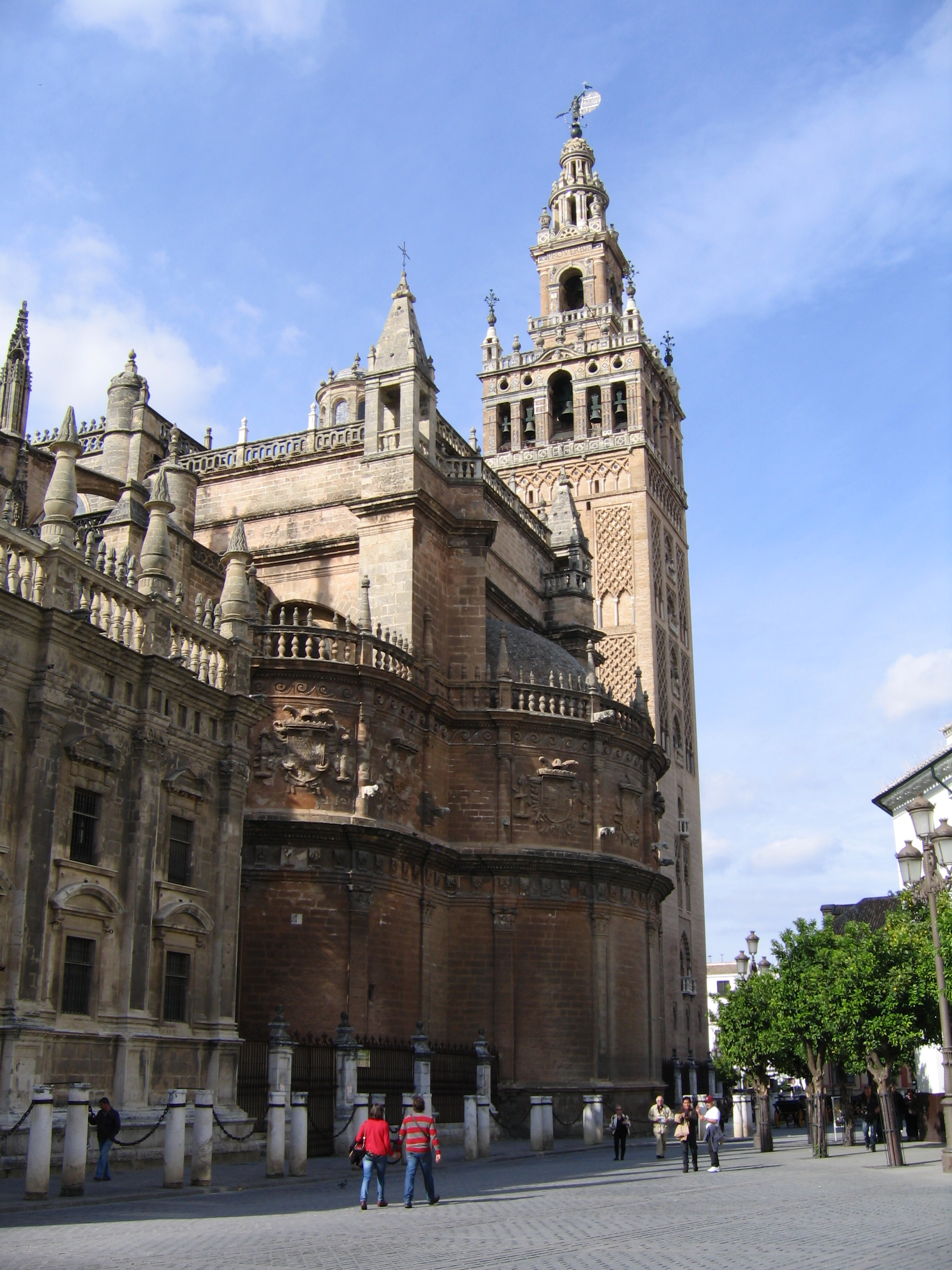
Catedral de Sevilla
The architecture and art of Sevilla is an amazing combination of Classic Spanish, Roman, Moor and Jewish influences. We spent a bit of time at Sevilla’s Cathedral, the third largest cathedral in Europe after Rome’s Basilica and London’s Saint Paul’s. Also, we visited the huge Plaza de España, the Spanish Pavillion for a World Expo, and what is now the Univesidad de Sevilla, the building where the fictional Carmen of Mérimée/Bizet’s fame was said to have worked. Just when we thought we got the overall mix of architecture, we came upon Plaza de la Encarnacion and the new Metropol Parasol, the world largest wooden structure, http://www.yatzer.com/Metropol-Parasol-The-World-s-Largest-Wooden-Structure-J-MAYER-H-Architects.
We did sit around and drink coffee a lot and watched people, our favorite sport. We enjoyed Sevilla’s people the best. We saw stereotypical romantic Europeans stopping at a street corner just to make out, German tourists in sandals and socks, and loud Brits. Which reminds me; Americans get a bad rap about being ugly and loud, but British tourists seemed to be more obnoxious, more demanding of special treatment, and louder than everyone else. I now wonder if Europeans think that every obnoxious person speaking English is American, when they might be from Kent?
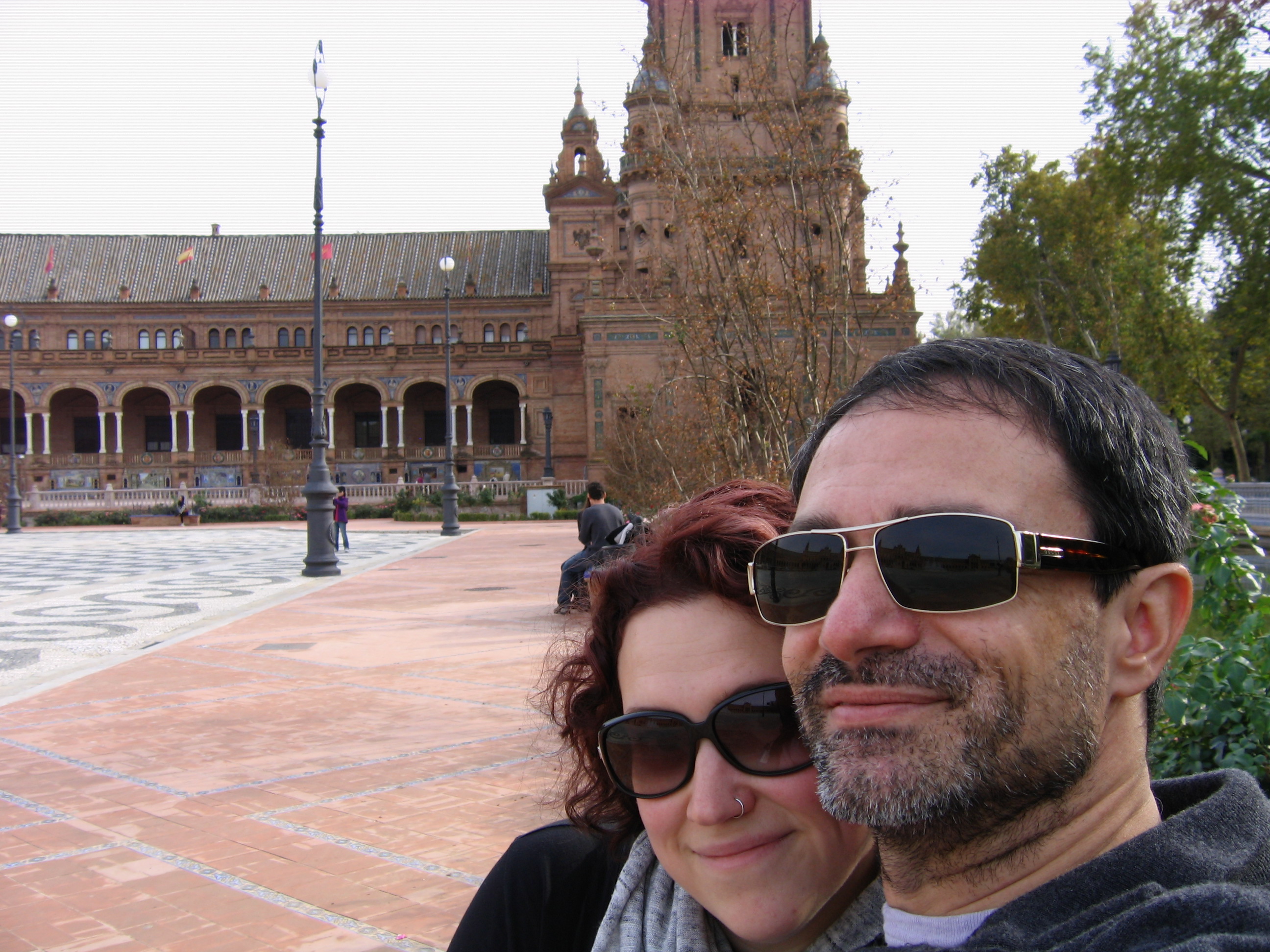
Mandy and Me at Plaza de España, Sevilla
In Sevilla we found a Cuban tapas restaurant, with a large vegetarian menu. We made sure we ate there a couple of times. Why can’t we have restaurants like that in the Boston area? I could go for some fufu and yucca right now.
We liked Sevilla the best from the three cities. It was grittier, but more real, more accessible. The city seemed to be filled with happiness. We also stayed at the coolest hotel, a building built in the 16th century, that while maintaining its original architecture inside, it was updated and felt very modern, and clean.
The last bit of our trip was going back to Madrid. This was my last chance in this trip to get a good look at Ciudad Real, as our train stopped there. The train trip, like the others was fabulous. Arriving to Ciudad Real was similar to arriving at some of the other cities that we went by, like Zaragoza. However, I did get a bit emotional seeing what I could see from the train. I tried to get a couple of pictures but none of them came out. Still, I was a few miles away from my ancestral home and for the last time I thought that my ancestors had seen this very area hundreds of years ago.
Aside from the sights, sounds, smells and flavors that I now carry in my memory of the mother country, I was able to put it in some sort of context in my head. Long ago when I first arrived to the US, I was embarrassed to tell people that I was Colombian, or Spanish. The way that mainstream Americans seem to think of Latinos has changed for the better, but only a little since. However, I’ve been very proud of my roots for many years. I can now be proud of what I still have in me of beautiful Spain, and I can say that I understand it better, having spent a few days there.
I’m still not going to eat their jamon Iberico, nor am I ever going to attend a bull fight, but I feel part, however distant, of the country that are the current Football World Champions, that gave us the insane creativity of Gaudi, or that gave us Lorca and Cervantes.
“Españolito que vienes al mundo te guarde Dios, una de las dos Españas ha de helarte el corazón.” Antonio Machado
Today is World AIDS Day. When I heard that this morning, I was transported back to the 80s. This happens nearly every year when this day comes around. Someone tells me about it, and I’m right back there on a train making my way to Baltimore from New York City.
I was in my early twenties just out of college, and on my way to visit a friend that had just moved to Maryland. I was sitting on the window seat. Next to me was a very well dressed man in his 50s. He introduced himself to me, right as the train began to pull away from Grand Station. I have forgotten his name, but in the years since I’ve always wished that I could remember it.
He said that he was on his way home to visit his parents. He hadn’t visited them in a long time. The way that he said it made me think that he wished they were close, but something had driven them apart. I remember asking how long he had lived in New York. “A lifetime,” was his response.
He asked me about my trip, about my friend, about what I was doing with my life. The conversation flowed, unlike any conversation I have ever had with a stranger. When I was younger I was very shy. The idea of just sitting around and chatting with a stranger would have filled me with dread. Yet, this man was very engaging. He made me feel at ease. I told him about my disappointment of having just graduated with a degree in engineering, and yet there were no jobs for engineers. I told him I was thinking of taking a job in an insurance company. I was afraid of getting stuck in career I never wanted.
He listened intently wanting to understand what was behind my words. He asked me about my expectations, “what do you want to do?” I talked about working for a great innovative company, or even better work for NASA. He agreed, that certainly an insurance company was not NASA, on the other hand how long was I going to sit around waiting for NASA to come knock on my door? I wasn’t sure how I could answer that. I hadn’t expected to have a problem getting my foot in the door are at least a defense contractor, which of course could be a great path to my goal.
I remember seeing him shake his head. “So you want to work for a company that makes weapons that kill people?” He didn’t say it in an accusatory way, just still trying to understand me. I became a bit defensive, having just spent a few days struggling with an application for a job at Aberdeen Proving Grounds. I told him that I loved math and science, and unfortunately this was the only real option for a Mechanical Engineer, at that time.
He stared at the back of the head of the person in front of him for a while, quietly. Softly, he said “you know Alex, you need to ask yourself a question, what will you do to get to your goal?” still staring ahead. I knew my answer to that. I didn’t want to be working at the Aberdeen Proving Grounds on ordinance, or biochemical weapons. I didn’t want to be designing ladders for jet fighters at Grumman, like one of my former classmates that had miraculously landed a precious new job. None of those things would be worth getting to NASA. I told him so.
“I’m guessing NASA is not where you are going to be, then.” Those words stung for a while, and just as that conversation ended another one began about something else. I’m sure it was something less important to me at the moment. Soon we were arriving to Philadelphia. Some people left the train and others got on. We continued our conversation.
A few miles outside of Philly, he began to tell me about moving to New York in the early 60s, when he was in his twenties. He didn’t get along with his family, and had no friends to speak of. New York was a new start. It was a place where he could be himself, or at least that is what he thought. It took a while but by the early 70s he was surrounded by a large group of friends, which became his real family. He spoke of a great group of people that scraped by in Manhattan, but always managed to save for great getaways to the Berkshires, Fire Island, or maybe Provincetown.
He knew that to get that wonderful life he had to give away his biological family. When they found out about what he “was doing in New York city,” they told him that he was going to hell. They told him that he was no longer their child, brother, or cousin. From time to time the ice would thaw a little and he would visit Baltimore. The freeze would come back quickly usually within a day or so, when someone decided to confront him about his terrible lifestyle that was “against God’s wishes.” He would leave quickly and go back to his New York family, where consolation was available easily.
I asked him if this trip was one of these thaws. He said that it was, but this time it was different. “I know that this is the last time I will be going back to Bal’more.” He said this very wistfully. He leaned over and softly said “I’m going home to say goodbye.” I wasn’t sure I understood. I asked what he meant.
“I have AIDS,” he said moving away from me. I thought I saw him wince. Maybe he waited for the face of panic, or confusion, or perhaps hate. I wasn’t sure how to respond. This was the first time I had knowingly been next to someone with AIDS. “I’m sorry,” I muttered. He smiled and moved closer again. I asked him about his prognosis. He said he had maybe months. I asked him if he was scared. He was only tired, he said. He had already lost his partner, and many of his New York family were also sick.
I grabbed his hand and held it. I wasn’t sure what if anything that would mean to him or me. It felt like the right thing to do. Just as quickly as we had moved from one subject to another we left this topic and moved on. I let go of his hand, and we continued being fast friends for a while.
As the conductor called for Baltimore, we began to gather out things. The train stopped and people got up at the same time, trying to get out. We waited a little bit for the train to clear out. We said goodbye to each other, clumsily. He opened his arms and offered me a hug. We hugged for a moment. He told me to stay out of trouble. I told him to take care.
I never interviewed with Aberdeen Proving Grounds, nor worked for a defense contractor. I found my dream career, but it was not in NASA, and it did start in insurance. I never forgot my few hours with this man. I don’t remember his name, but I will never forget him.
 The Strange Museum